
The following is an opinion piece by POLARIS Senior Advisor John Noonan. You can find the original op-ed here in National Review.
While the wars in Iran and Ukraine and other global crises command attention, many have overlooked the daunting challenge facing President Trump in the nuclear realm: for the first time ever, America faces not one but two peer adversaries that each represent an existential threat to our way of life.
The Trump administration inherited the most complex nuclear challenge in history — but this moment is as much opportunity as it is crisis. Over the next three years, Trump has a golden chance to launch the nuclear renaissance America needs, rebuild a deterrent second to none, and deliver homeland defense for the 21st century.
Success begins by understanding how progressive arms-control orthodoxy failed. For decades, the global elites have clung to false assumptions: that treaties guarantee stability, restraint is reciprocated, and America’s nuclear arsenal will soon be unnecessary with the arrival of a peaceful and benign global order. Those illusions have collapsed; Russia’s treaty violations and China’s nuclear breakout have upended every legacy framework the left relies on.
Biden’s 2021 unconditional New START Treaty extension exemplified this delusion, locking America into a bipolar arms-control regime in a tripolar nuclear world. The treaty imposed numerical limits on the United States while leaving Russia’s vast stockpile of tactical nuclear weapons untouched and China’s nuclear expansion unconstrained.
The results were predictable. China accelerated and expanded its buildup. Russia exploited the treaty’s shortcomings to rebuild its entire arsenal and develop new city-killing weapons. Nevertheless, under Biden, U.S. policy remained unchanged — ignoring these developments.
By refusing to extend New START last month, President Trump rejected this folly and affirmed reality: arms control divorced from the threat environment creates danger, not stability.
The Trump administration’s nuclear playbook should build on that conviction by focusing on three key pillars: modernize the triad, expand the arsenal, and defend the homeland.
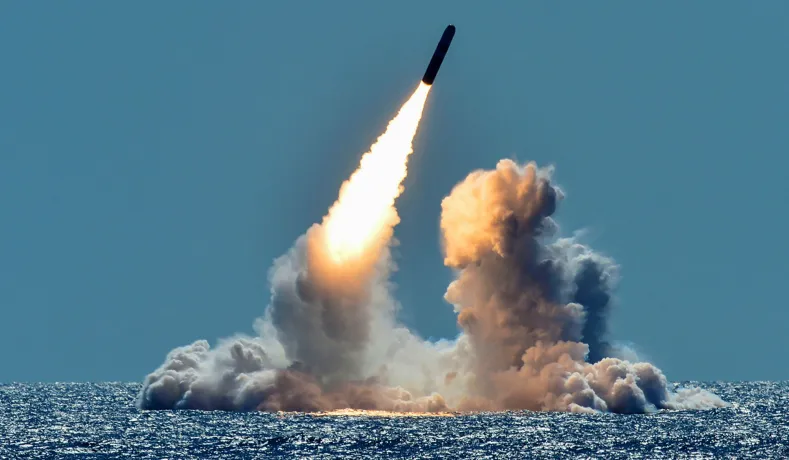
A nonnegotiable for MAGA nuclear policy should be modernizing the triad. Our triad is the foundation of deterrence and can give us a decisive edge over rivals, but only if it works as designed. As Senator Deb Fischer (R., Neb.) has stated, modernization is “not a matter of choice but of survival.” That means funding the Sentinel ICBM; fielding a robust fleet of B-21 Raider strategic bombers; expanding survivable sea-based capabilities, including a nuclear-armed sea-launched cruise missile; and rebuilding our aging Cold War–era nuclear-weapons production infrastructure. Deterrence cannot rely on legacy systems or rosy assumptions about Chinese and Russian restraint. It requires hard power with sufficient numbers, survivable forces, and flexible options to keep Moscow and Beijing guessing.
Second, the Trump administration should expand our nuclear arsenal — strategic and tactical. Modern delivery systems are insufficient if the underlying stockpile is too small for the mission. Washington must come to terms with the reality that arms-control advocates resist: deterring two nuclear peers requires more and different nuclear weapons than deterring one.
Also urgent is expanding America’s nonstrategic nuclear forces. The United States fields around 200 tactical nuclear weapons; Russia fields around 2,000. This imbalance is all but an invitation for Russian coercion.
Once expanded, these weapons should be deployed in theater to Europe and the Indo-Pacific. Tactical nukes provide limited deterrent value sitting in U.S. storage vaults, but forward-deployed in places like Poland, Estonia, South Korea, and Japan, they can strengthen deterrence and lower the risk of nuclear blackmail.
Third, we need to advance Trump’s initiatives to defend the homeland, including and in particular the massive Golden Dome project. Deterrence is necessary but not sufficient. Missile defense raises the cost of attacks and complicates our adversaries’ planning.
The Golden Dome is the most serious opportunity in decades to build a layered national missile defense. As Reagan saw with his Strategic Defense Initiative, Trump recognizes that deterrence is strongest when adversaries question their abilities to strike and control escalation.
The United States does not seek an arms race. But in a world where its adversaries sprint ahead, unilateral restraint becomes synonymous with surrender. As Trump stated in 2016, if others insist on an arms race, America must “outmatch them at every pass and outlast them all.”
The goal of America’s nuclear policy should always be peace — but as Biden proved, that will never be secured through concession. Deterrence works when U.S. strength is unmistakable and its resolve unquestionable.
John Noonan is an adviser to POLARIS National Security. He is a former congressional staffer and veteran of the United States Air Force.