
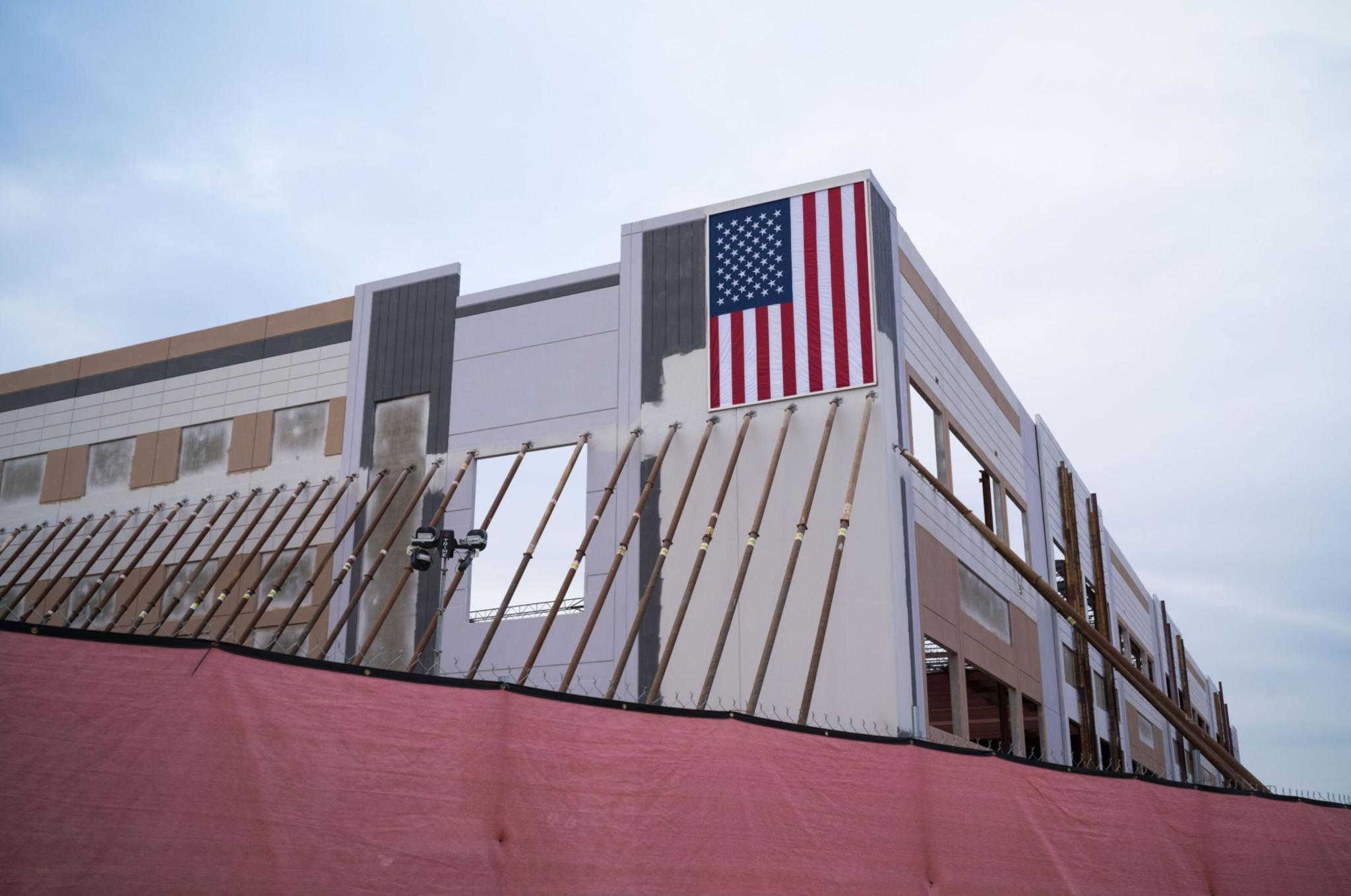
The following is an opinion piece by POLARIS Senior Advisor John Noonan. You can find the original op-ed here in National Review.
Every few decades, a technology emerges that changes the balance of power among nations. The countries that master it gain extraordinary economic and military advantages. Those that fail to adapt fall behind and eventually find that the world has moved on without them.
The 14th-century Ottomans harnessed gunpowder; 16th-century Spain mastered navigation; 19th-century Britain harnessed industrialization. All rose to preeminence; all eventually lost it. Their failure to adapt to the next technological era contributed to their decline.
Today, the technology that could define the next century is AI, and the United States cannot afford to lose.
China understands this, which is why Beijing is scaling its AI capacity, investing hundreds of billions of dollars in data centers, semiconductors, and computing infrastructure. Its data center capacity is projected to more than double by 2030.
China is not waiting for the future to arrive. It is building it, and the United States must do the same.
The world’s most advanced AI models do not exist in a cloud. They exist in buildings filled with chips, servers, cooling systems, fiber, transformers, and vast amounts of electricity.
AI models are becoming instruments of national power, and data centers are the factories that produce them. During the industrial age, guns, ships, railroads, and aircraft became instruments of national power, but none could be produced without factories, steel mills, machine tools, and assembly lines behind them. In the AI age, the equivalent infrastructure is compute.
If America wants technological supremacy, it needs compute supremacy. That is why the campaign to slow or stop America’s data center buildout should be taken seriously.
Communities can seek responsible development. They can negotiate over electricity costs, land use, water, and infrastructure. But America can build faster without abandoning common sense. It cannot respond to China’s AI buildup by putting itself in a technological straitjacket.
The nuclear age is instructive here. Arms control can have a legitimate role in great-power competition, but deterrence depends on maintaining the capabilities necessary to deter. The United States did not preserve the peace by declaring its arsenal obsolete. The same principle applies to AI.
Senator Bernie Sanders and Representative Alexandria Ocasio-Cortez have proposed a federal moratorium on AI data centers until national safeguards are established. Such restraint would come as our chief rival simultaneously expands its AI infrastructure and semiconductor industry.
The United States does not seek a technological race for its own sake. But unilateral technological disarmament is not strategy; it’s surrender.
Winning that race will require infrastructure, beginning with permitting reform. Data centers require enormous investments in power generation, transmission, land, and construction. These investments were overdue long before data centers became a nuclear-level political issue. The administration’s 2025 executive order identified AI data centers and their supporting infrastructure as critical to national security, economic prosperity, and scientific leadership, and it directed agencies to accelerate permitting. States and localities should do the same.
Supply chains also warrant close attention. China has demonstrated its willingness to weaponize economic dependencies. America needs secure domestic access to the chips, critical minerals, energy, and equipment required for the AI revolution. That means more semiconductor manufacturing, a stronger electrical grid, and strategic reserves of critical minerals.
It also means building things here in the U.S. Energy, fabs, and data centers cannot be leapfrogged by better software; they have to be poured, wired, and powered. Off-shoring the foundation of America’s technology creates vulnerabilities to espionage, disruption, and intellectual-property theft.
I don’t like what the Chinese Communist Party is up to. It is meddling in this debate. OpenAI recently disclosed a likely PRC-origin influence operation that used AI to generate social media content criticizing U.S. data center construction and AI infrastructure. The campaign sought to amplify concerns about data centers, including those about water and electricity prices.
Beijing recognizes that data centers are a strategic vulnerability for America and is working to exploit our political divisions. China wants to build its own compute while making it harder for America to build ours. We should fight it, not help it.
John Noonan is an adviser to POLARIS National Security. He is a former congressional staffer and veteran of the United States Air Force. @noonanjo