
PDF version here.
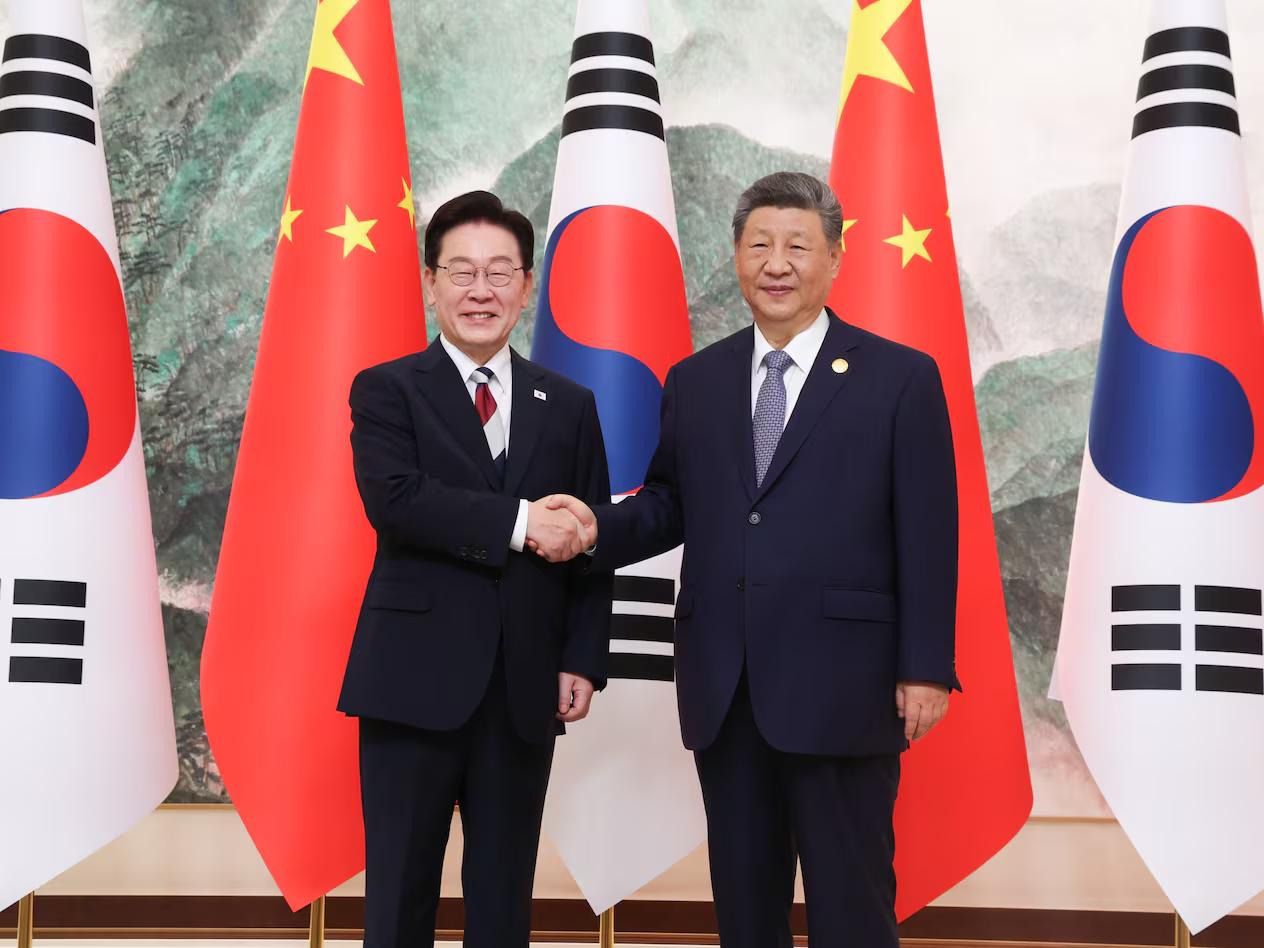
Earlier this week, South Korea’s President met once again with Xi Jinping, earning him a new distinction: the CCP’s most frequent presidential visitor of the year. But the repercussions of Seoul’s growing alignment with China extend well beyond summit diplomacy. By continuing to court Beijing, hand the CCP economic leverage, and undermining its defense relationship with America, South Korea’s leftist government is weakening U.S. security in the Pacific and giving Beijing strategic openings to exploit.
President Lee’s Deference to the CCP Endangers America–and South Korea
- Few nations have more to lose from China’s threats to regional security than South Korea–but that isn’t stopping President Lee’s misguided overtures. While the CCP provides North Korea economic lifelines and even a new bridge, Seoul courts the power strengthening its top foe, which wants South Korea wiped off the map.
- Seoul’s left-wing turn is accelerating its alignment with the CCP. The Minju Party notably celebrated the CCP’s centennial, displaying its flag alongside communist parties from America’s adversaries.
- South Korea is already dangerously dependent on Communist China. It relies on China for nearly half its rare earth imports, has opened its market to Chinese semiconductors, and sought new agreements on technology and intellectual property.
- These choices deepen that dependence. Seoul and Beijing agreed on additional measures towards a Free Trade Agreement during the meeting, deepening economic ties at a time when Seoul is slow walking the commitment it made last year to the U.S.
- As POLARIS documented months ago, Seoul’s growing dependence on China is fueling serious concerns about security in the Pacific and damage to its alliance with Washington.
South Korea Keeps Bolstering China’s Leverage
- Seoul’s authorities, led by the Korea Fair Trade Commission (KFTC) under Chairman Ju Byung-ghi, continue to favor Chinese business while punishing its American counterparts. That isn’t just a commercial matter–it’s tilting Asia’s economic competition in the CCP’s favor by enhancing its economic influence at America’s expense. This has come at a time when the United States and Korea should be deepening their economic security ties in the face of increased competition from China.
- Discrimination against U.S. companies is not an isolated incident—it’s a pattern that is accelerating. One American company, Coupang, was just hit with a massive $220 million fine—600 times more than a similar 2020 case. Google is also reportedly facing a fine from the KFTC that could reach more than $550 million.
- That fine is just the latest example of Korea’s attacks on American business. Over the last decade, U.S. companies have faced 43 penalizing decisions. By contrast, China only received nine despite China being Korea’s largest trading partner.
- Seoul is handing American businesses massive penalties relative to their market share in Korea. One study indicates U.S. companies faced nearly a quarter of all penalties–$1.3 billion total–despite only comprising 4% of the market.
- Seoul imposes far fewer penalties on businesses from Communist China. Over the last decade, the total value of Korea’s penalties against Chinese firms was just $11.7 million. That leaves U.S. businesses penalized at up to 93 times the rate of China’s at the same time that Chinese firms are prompting thousands of consumer complaints.
- Now, Korea’s regulators are seeking more aggressive changes, tilting the playing field even more toward Communist China. They are pushing to increase compliance burdens on U.S. businesses including through new platform legislation and amendments to existing laws while leaving Chinese firms largely untouched.
- Seoul’s attacks are setting a dangerous precedent for American businesses. If South Korea is allowed to bully U.S. businesses and dismiss concerns from Congress and the Trump Administration, what will stop other nations from replicating these tactics?
- As President Trump’s National Security Strategy made clear, he sees economic attacks as defense threats. Strengthening shared economic security is a precondition for strong defense ties–while letting it falter fuels fallout beyond commerce.
Korea’s Drift Toward Communist China Risks Security Fallout
- South Korea must stop handing Communist China leverage by weaponizing its bureaucracy against America. Creating market conditions that bully U.S. companies out and invite Chinese ones in hands Beijing an economic lever to pull during a crisis–and South Korea’s history shows Beijing has every intention of using it.
- The CCP is no stranger to bullying Seoul with economic coercion. When Korea hosted an American THAAD battery, Beijing went haywire: Chinese consumers boycotted goods, Chinese tourism fell sharply, and the land provider became a CCP target. There’s every reason to believe Beijing will keep trying to bend Seoul’s behavior.
- America is counting on Seoul to hold firm in a crisis. 28,000-plus American soldiers serve in South Korea. If fear of Chinese retaliation deter South Korea from standing with the West, it’s American forces in harm’s way who stand to lose.
- Unfortunately, the Lee government has signaled weakness to Beijing. The President has dismissed the importance of deterring an invasion of Taiwan, questioning “what does it matter to us” if the CCP conquers the island.
- Korea’s pursuit of closer ties with the People’s Liberation Army also raises serious concerns. The South Korean Defense Ministry has explored “bilateral cooperation in the defense sector” with China. American treaty allies should not be trying to bolster cooperation with our military’s near-peer competitor.
- South Korea’s courting of the PLA is all the more concerning given Seoul’s push to transition wartime operational control of the U.S.-South Korea Combined Forces Command to a Korean general. Why would we place American lives in the hands of an ally lobbying America’s chief threat?
The Bottom Line: South Korea’s growing alignment with Communist China raises serious questions about its strategic direction and commitment to deterring our nations’ shared threats. Seoul has a responsibility to end its commercial targeting, reaffirm its respect for America’s security, and reassure the U.S. that the Blue House can still be trusted.